Ilia Strekalovski Is Bringing the Bayan into the Future

In an era where algorithms often reward speed over mastery and trends over tradition, Ilia Strekalovski has built something unexpected: a global audience of millions around an instrument many people have never heard of.
The bayan is a sophisticated Eastern European button accordion with deep roots in classical and folk traditions, and is one which is not typically associated with YouTube stardom. It doesn’t arrive with the cultural cachet of a vintage guitar, the ubiquity of a piano, or the instant recognition of a synthesizer. Yet for Strekalovski, the bayan has never been a relic of the past. It is a living instrument, capable of expressing everything from intimate emotion to cinematic drama, and he has spent much of his career proving exactly that. Today, Strekalovski stands at a fascinating intersection of old and new. He is a conservatory-trained musician, recording artist, multi-instrumentalist, music video creator, and digital entrepreneur whose online audience exceeds three million subscribers and hundreds of millions of views. But unlike many creators who discover music after finding success online, music came first for Ilia. Long before the cameras, before the views, before the subscribers, there was a child in the northern Russian town of Apatity staring at his father’s bayan. That moment changed everything.
The Instrument That Chose Him
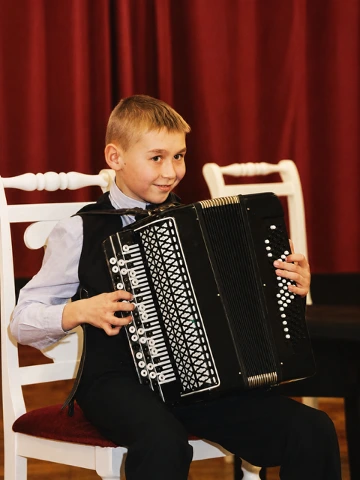
Strekalovski’s musical journey began when he was seven years old at the School of Arts in Apatity, a small town in Russia’s Murmansk region. Unlike many professional musicians whose artistic path begins with parental encouragement, it was Ilia’s idea to actively pursue this instrument. Captivated by the bayan he saw at home, he asked his parents to enroll him in music school. There, Ilia met the teacher who would alter the trajectory of his life. Viktor Nikolaevich Mashkov, director of the school and Strekalovski’s first instructor, recognized not only a talented child but an unusually determined one. Under Mashkov’s guidance, the young musician quickly immersed himself in the technical and emotional possibilities of the instrument. The bayan became more than a hobby, it became the pupil’s identity.
Competitions soon followed. Throughout his childhood and teenage years, Strekalovski accumulated awards at local, regional, and national competitions, developing the discipline and stage presence that would later define his professional work. In 2002, he received a scholarship recognizing his musical achievements from the Administration of the City of Apatity. The same year would deliver an even greater opportunity. At just ten years old, Strekalovski became a laureate of an international music festival and competition and received a scholarship from the Ministry of Culture of the Russian Federation. The recognition led him to Saint Petersburg, where he performed at the historic Sheremetev Palace before an audience of educators, musicians, and cultural leaders. When that audience called him back for an encore, something shifted. The performance attracted the attention of the director of the Secondary Specialized Music School affiliated with the N. A. Rimsky-Korsakov Saint Petersburg State Conservatory, who invited him to continue his education there. For a child from a remote northern town, it was the kind of moment musicians dream about. It also became the foundation of everything that followed.
Holistic Creative Freedom via Bayan
In the early 2000’s, Strekalovski studied at the prestigious Secondary Specialized Music School affiliated with the Saint Petersburg Conservatory before continuing directly into the N. A. Rimsky-Korsakov Saint Petersburg State Conservatory itself. His focus remained the bayan, but his education expanded beyond performance. He studied piano. He studied conducting. He immersed himself in harmony, musical form, ensemble thinking, and interpretation. The result was a musician who understood music not only from the perspective of a performer but also as an architect. That breadth of training continues to influence his work today. For Strekalovski, the bayan remains uniquely expressive because it allows a single performer to carry melody, harmony, accompaniment, rhythm, and texture simultaneously. “It is a complete means of self-expression,” he has said. Unlike instruments that depend heavily on accompaniment, the bayan allows him to construct entire musical worlds alone. Its dynamic range and tonal flexibility make it equally suited for introspective passages and dramatic crescendos. The instrument breathes. The player breathes. The performance becomes a conversation between the two.

The Concerts That Defined a Career
Several live performances stand out as defining moments in Strekalovski’s development. His 2002 appearance at Sheremetev Palace was a performance that transformed possibility into reality and opened the door to professional musical training. More than a decade later, another concert would prove equally significant. In November 2013, his band performed at Saint Petersburg’s A2 Club as the opening act for Russian artist Noize MC before an audience of roughly 5,000 people. By this time, Strekalovski was already exploring ways to integrate the bayan into contemporary music. Rather than treating it as an exotic novelty, he positioned it as the central voice within a modern ensemble that combined elements of alternative rock, songwriting, and academic musicianship. This performance validated years of experimentation for Ilia. The live audience responded enthusiastically, and social media growth followed. This demonstrated that listeners were willing to embrace the bayan in contemporary contexts. A similar realization emerged during a March 2026 concert at Rassvet Club in Saint Petersburg. Unlike earlier performances centered on interpretation, this event focused on original material and reflected Strekalovski’s evolution into a complete artist who was equal parts composer, frontman, performer, and creative director. The concert served to once again establish that this instrument could thrive not only within classical repertoire but also inside an original contemporary music project.
Building a New Audience for an Old Instrument
For many musicians, the internet functions as a promotional tool. For Strekalovski, it provides something even larger. His earliest successful YouTube videos featured bayan performances and arrangements of popular songs. At a time when most online music content focused on guitar, piano, or electronic production, the sight of a conservatory-trained bayanist reimagining familiar material felt fresh. Viewers responded and Ilia’s audience grew. What began as music content eventually expanded into large-scale projects involving engineering, automobiles, aviation, travel, and technology. Over time, his channel developed into one of the largest independent Russian-language platforms in its category. Music was always present, evolving alongside everything else. The same creative instincts that guided his musical work also shape his visual storytelling. Ilia’s videos emphasize process, craftsmanship, experimentation, and discovery. Whether he is performing a musical arrangement or documenting a complex engineering project, the underlying philosophy remains remarkably similar. Tradition becomes a foundation for innovation rather than a limitation. The resonating message proclaimed that what has already been established is merely a starting point; one to be utilized and respected while being a catalyst for individual expression.

Recalibrating the Creative Path
In an age obsessed with what’s next, Strekalovski has built a career around demonstrating the enduring relevance of what already exists. He rejects the notion that tradition and modernity are opposing forces. The bayan, after all, is a historical instrument but history does not make it obsolete. Instead, Strekalovski sees tradition as raw material. The same way an engineer builds upon earlier discoveries, a musician can build upon centuries of musical heritage while creating something entirely contemporary. His music videos, original releases, and digital projects operate according to this principle. The visual language may be modern. The distribution may be global. The audience may span continents. But the musicianship remains rooted in years of study, performance, discipline, and respect for the instrument itself. That balance helps explain why his work resonates with audiences who may have never encountered the bayan before. Ilia is not presenting it as a museum piece but rather as a living voice.
A Reversal of the Artistic Perspective
Today, Ilia Strekalovski continues developing new music, visual projects, collaborations, and live-performance concepts designed to further expand the bayan’s presence on the international stage. His ambition far exceeds that of subscriber counts or view metrics. The goal is cultural. Ilia wants to demonstrate that traditional musicianship still has a place in contemporary media. He is intent on showing that classical training and digital creativity can coexist. His own life and career are steadily proving that a musician from a small town can carry a centuries-old instrument into entirely new spaces. For many artists, success means adapting themselves to fit the moment but Strekalovski’s career suggests a complete reversal of this concept. Ilia is committed to exhibiting that success comes from bringing the past with you—and convincing the future to listen.