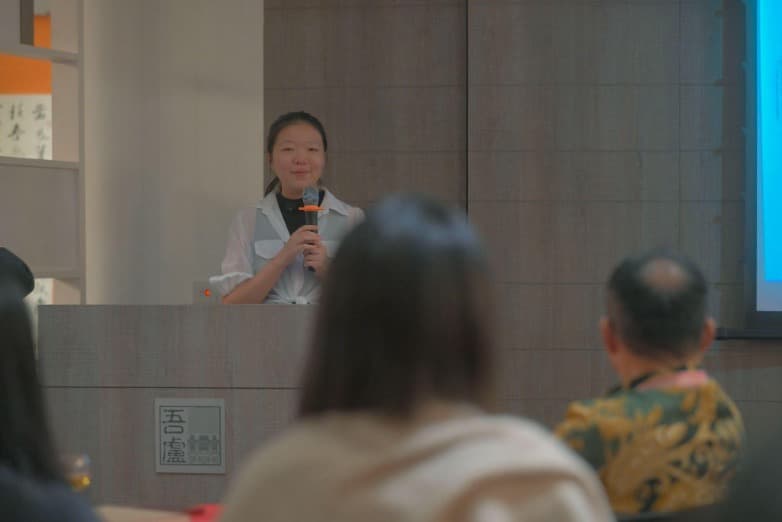
Photo Courtesy: Yuchi Tairan presenting on the idea of social responsibility embodied by figures in the Song dynasty at Goh Loo Club in Singapore.
In Shenyang, Yuchi Tairan found herself inside a local mosque on Eid al-Adha. She had gone with her grandmother, who knew the Hui Muslim neighborhood from childhood. Tairan expected an older crowd. Instead, she saw students from different countries listening as the imam drew connections between Islamic values and Chinese culture.
What stayed with her was the translation happening in real time. The imam used Chinese idioms and alluded to Journey to the West, the Ming dynasty classic, to explain ideas rooted in another tradition. “He was making that link, that synthesis between the Islamic faith and Chinese culture,” Tairan recalled.
For many teenagers, that might have been an interesting travel memory. For Tairan, only 17, it became part of a larger question: how do cultures meet without erasing one another?
Raised in Singapore by parents who are first-generation immigrants from Northeast China, Tairan grew up in a multicultural society while still trying to understand her own inheritance. Because her surname has two characters, she said, people sometimes ask whether she is Japanese. For her, identity has never been a fixed label. It is something people read, misread, translate, and explain.
Her earliest route into history was playful. In primary school, she and a friend wrote a comic book that reimagined Chinese myths. In their version of Chang’e, the moon goddess did not simply take immortality pills and fly away. She got hungry and ate nine suns. It was silly, but it revealed something that remains in her work: Tairan is drawn to the way stories shape a people’s sense of themselves.
By secondary school, that curiosity had sharpened. She chose history and literature and began to see the humanities not as a pastime but as a way to read the present. The Russo-Ukrainian war, she said, made lessons on the Cold War feel less remote.
Her most ambitious academic project so far is a research paper, shortlisted by The Concord Review, on the development of Islam and Christianity in China during the Ming and Qing dynasties. The subject began partly through a friend’s interest in East Asian studies and the Jesuit missionaries who adapted to local culture. It deepened through Tairan’s own encounter with Hui Muslim traditions in China.
The surprise, she said, was that Hui Muslim scholars also used Neo-Confucian vocabulary to explain their worldview, even though they were not trying to convert others. “They already had philosophical vocabulary from Persianate and Arabic sources,” she said, “but they also seriously studied Neo-Confucianism.”
That insight changed how she thinks about coexistence. Living in Singapore, where broad racial categories can make communities look more uniform than they are, Tairan came away from the research wary of easy labels. “We should never assume that any particular people group is a monolith,” she said.
Her interest in cultures has not remained in books. At a traditional Chinese medicine center in Clementi, Tairan helped prepare foot baths, learned to use traditional equipment, assisted with gua sha under guidance, and spent time with older patients while they waited. The work exposed her to a quieter archive of human life, one made of small aches, family stories, physical strain, and ordinary resilience.
One patient she remembers was an older delivery rider who had traveled some distance because his body felt stiff and painful. He was told he should return weekly, but he worried he did not have time. Tairan saw in him the cost of overwork, and the moment shifted the way she thought about service. History, she realized, should not be about empires and dynasties alone. “Ultimately, the study of history is to build historical empathy,” she said.
That phrase, historical empathy, also sits at the center of Youth Accord, the youth-led platform Tairan founded to encourage young people to engage with global issues, intercultural dialogue, and social impact. Its early work includes educational resources, a developing website, and a Learning Planet Festival presentation on Song dynasty governance and its links to the present. Tairan was surprised when the niche presentation drew hundreds of views.
Her goal is not to make every teenager a historian. It is to make them less indifferent. Youth Accord, she said, is meant to help people her age realize that being involved in society “is not only for adults.” In the near term, she hopes to build visibility through videos, resources, and connections with like-minded organizations. Long-term, she wants to create virtual and physical spaces where students can discuss culture, current affairs, and community concerns.
A student who once clustered with those who shared her background now wants to build bridges across differences. She studies the past not to escape the present, but to understand how people live inside it. In Tairan’s hands, history is not a museum piece. It is a language for listening.